Drive along Spring Bayou this month and you will see it: orange fencing along the boat ramp at Craig Park, a barge working the shoreline, sheet pile going in a foot and a half in front of the old wall. It is hard to miss, and if you are shopping for a bayou-front bungalow or a canal home near Lake Tarpon this fall, you have probably driven past it and filed it under good news. The city is finally fixing its seawall.
It is good news, and it has nothing to do with the seawall behind the house you are about to make an offer on.
What $2.78 million actually buys
According to Yahoo News, in May 2026, Tarpon Springs city commissioners voted unanimously to approve a $2.78 million contract with Florida Solid Solutions, doing business as Florida Seawall Solutions, to rebuild the failing seawall and sidewalk around Craig Park. A $2 million federal grant covers most of it, with the rest coming from the city's borrowing package. The old sidewalk sat about two feet above sea level. The new wall targets five feet above sea level, higher than the old sidewalk, and is built with tiebacks, anchors, and a reinforced concrete cap set about eighteen inches in front of the original structure.
As reported by Tampa Bay Beacon, the project is split into two stretches: an 800-foot western run from the boat ramp to the Beekman parking lot, and a 1,200-foot eastern run from there to the observation deck. City officials expect substantial completion by early December, timed to clear the way for the Greek Epiphany Celebration on January 6, 2027, the event that has drawn international attention to Spring Bayou since the early 1900s.
Not everyone at city hall agrees the work is unfolding as promised. In August, Commissioner Michael Eisner told colleagues the work on the west wall does not match what commissioners were told to expect, since that stretch is getting a new cap on the existing structure rather than a full wall replacement. City Manager Mark LeCouris and staff maintain the contractor is on track and that the discrepancy reflects engineering findings, not a change in scope. That disagreement is playing out in public commission meetings, which is worth sitting with for a second, because it is the closest thing you will get to watching a seawall dispute happen in real time before you ever sign a contract on your own.
Where the grant money stops
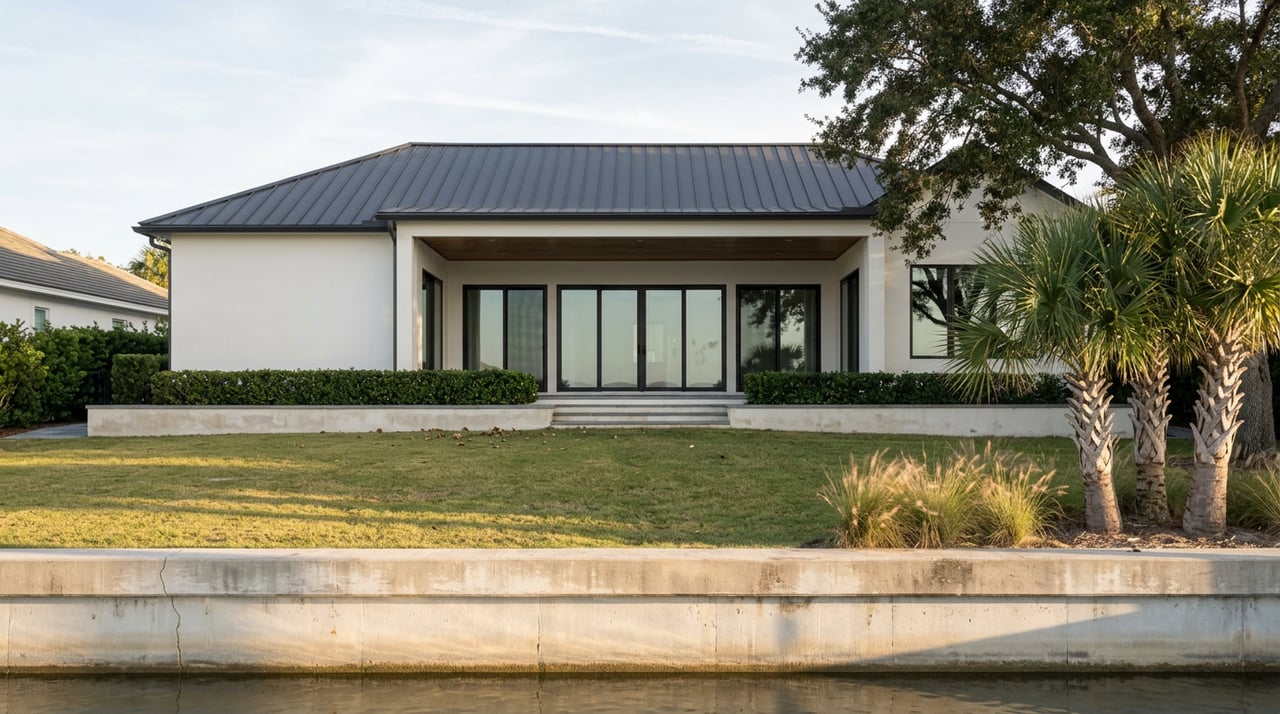
Here is the part that matters if you are not buying a house that borders Craig Park itself. The $2 million federal grant and the city's contribution cover the waterfront from the boat ramp to the observation deck. The north side of Spring Bayou is a separate, later phase with no funding attached yet. And every foot of seawall behind a private dock on Riverside Drive, Bayshore Drive, or any canal lot feeding into the Anclote River sits entirely outside this project. No grant touches it. No commission meeting debates it. It is a private asset, on private land, and its condition is entirely the current owner's problem until the day it becomes the next owner's problem.
That is the gap the Craig Park story exposes. A public seawall failing in slow motion gets an independent engineering study, a bid process, and two years of public debate before a shovel goes in the ground. A private seawall failing in slow motion gets noticed by the homeowner, or it doesn't, and either way the law has something specific to say about what happens next.
The disclosure law nobody explains until it's too late
Florida does not require sellers to fill out a standardized state disclosure form the way some states do. What Florida has instead is Johnson v. Davis, a 1985 Florida Supreme Court decision that still governs every residential sale in the state. The rule from that case is straightforward: if a seller knows about a fact that materially affects the value of the property, and that fact is not something a buyer could reasonably discover on a normal walkthrough, the seller has to disclose it.
A cracked or undermined seawall is exactly the kind of thing this rule was written for. It sits below the waterline. A buyer touring the house on a Tuesday afternoon is not going to see the void forming behind the cap or the corrosion on a tieback. If the seller has had the wall inspected, patched a section, or filed an insurance claim tied to storm damage, that is knowledge. Writing "as-is" into the contract does not erase it. An as-is clause addresses the physical condition a buyer is agreeing to accept for repair purposes, it does not release a seller from the separate legal duty to say what they know.
Waterfront property in Florida carries one more layer on top of that. Under Florida Statute §689.261, sellers of coastal property have a specific statutory obligation to disclose erosion issues and the property's position relative to the coastal construction control line. That statute exists independently of Johnson v. Davis, and it applies whether or not the seller thinks the seawall is in good shape, because erosion disclosure is about the land itself, not just the structure sitting on it.
Public wall, private wall, side by side
| Craig Park (public) | Your waterfront lot (private) | |
|---|---|---|
| Who pays | $2M federal grant plus city borrowing | The homeowner, in full |
| Engineering review | Independent analysis commissioned before work began | Whatever the buyer or seller chooses to order |
| Disclosure requirement | None, the city owns the asset | Johnson v. Davis plus F.S. §689.261 |
| Typical cost | $2.78M for roughly 2,000 linear feet | $20,000 to $100,000 or more for a single residential wall |
| Oversight | Debated in open commission meetings | Surfaces only if someone asks, or after the fact |
That last row is the one worth sitting with. The Craig Park dispute is happening in public because a public seawall is public business. A private seawall's condition, and whatever the seller knows about it, generally stays invisible until a buyer's inspector finds a problem or an owner has to write a check. Seawall replacement costs for a single residential lot commonly run from $20,000 to well over $100,000 depending on length, material, and access, and that is not a number that shows up anywhere in a listing headline.
What to actually ask before you write an offer
A standard home inspection in Florida typically covers the house itself: roof, HVAC, plumbing, electrical, structure. It generally does not extend below the waterline. If you are buying anything described as waterfront in Tarpon Springs, whether it is on Spring Bayou, a Lake Tarpon canal, or the Anclote side near the Sponge Docks, add a separate line of questions before you get past the inspection period:
- How old is the seawall, and what is it made of? Concrete panel, vinyl sheet pile, aluminum, and wood age differently and fail differently.
- Has the seller ever had it repaired, and is there an invoice or contractor report?
- What does the cap look like up close? Hairline cracks are common. Spalling and visible displacement are not cosmetic.
- Are there any tiebacks or anchors visible, and do they show corrosion?
- If there is a dock or lift, what is its permitting history with the Florida Department of Environmental Protection, and does the lift capacity match the boat you actually plan to keep there?
If the answers raise questions the seller cannot document, a dedicated marine or seawall inspection before closing is a reasonable ask, and it is a far smaller cost than discovering the answer after you own the wall.
If you're selling, the duty travels with you
The Johnson v. Davis obligation does not end when the contract is signed. If a buyer asks a direct question about the seawall during due diligence and the answer is incomplete or misleading, that exposure continues through closing. If you had a section patched five years ago, or you filed a windstorm claim that touched the dock or bulkhead, that is the kind of documented, actual knowledge the law is built around. Disclosing it in writing, with whatever repair records exist, is the version of this conversation that protects everyone at the closing table, including you.
Frequently Asked Questions
Does the Craig Park project affect insurance costs for nearby private homes? Nothing in the project's scope touches private insurance. Premiums on an individual home are priced against that property's flood zone, elevation certificate, and wind mitigation report, not against a public works project a few blocks away.
Does a standard home inspection cover my seawall? Usually not in any depth. General home inspections are built around the structure above grade. What matters at a seawall, tieback condition, void formation behind the cap, corrosion, typically calls for a separate marine inspection.
Can a seller use an as-is contract to avoid disclosing a seawall problem? No. An as-is clause governs who fixes what before closing. It does not remove a seller's separate duty under Johnson v. Davis to disclose a known, material, non-observable defect.
Waterfront transactions in Tarpon Springs reward buyers and sellers who ask the right questions before the seawall becomes a surprise instead of a line item. If you are weighing a bayou, canal, or lakefront property here and want a second set of eyes on what a listing isn't telling you, Justin Aftanis has spent more than 25 years reading exactly these details across Pinellas County's waterfront neighborhoods. Schedule a consultation before you write the offer, not after.
This article is general information, not legal, tax or financial advice. Consult a qualified professional about your situation.